Public Warning
Communicate information and alert residents and visitors of imminent and developing emergencies with the only unified all-channel, intelligent population alerting platform.

The next generation population alerting platform
- Offers a truly comprehensive, flexible and modular public warning solution
- Meets the needs of all countries, small or large
- Helps to protect more than 800 million people across all five continents in more than 20 countries
- Complies with international standards and PII data protection, including EECC Article 110 and GDPR.
Innovations with Device-Based Geo-Fencing
Over the years, public warning systems have evolved to leverage Cell Broadcast to send life-saving messages to mobile phones, incorporating innovative technologies such as Device-Based Geo-Fencing (DBGF) to enhance their effectiveness.
To learn more about the evolution of public warning systems and delve into Device-Based Geo-Fencing, its significance, and the future of public safety measures, download our white paper, “Evolution of public warning systems: Innovations with Device-Based Geo-Fencing.”

Trusted worldwide
More deployments than any other provider
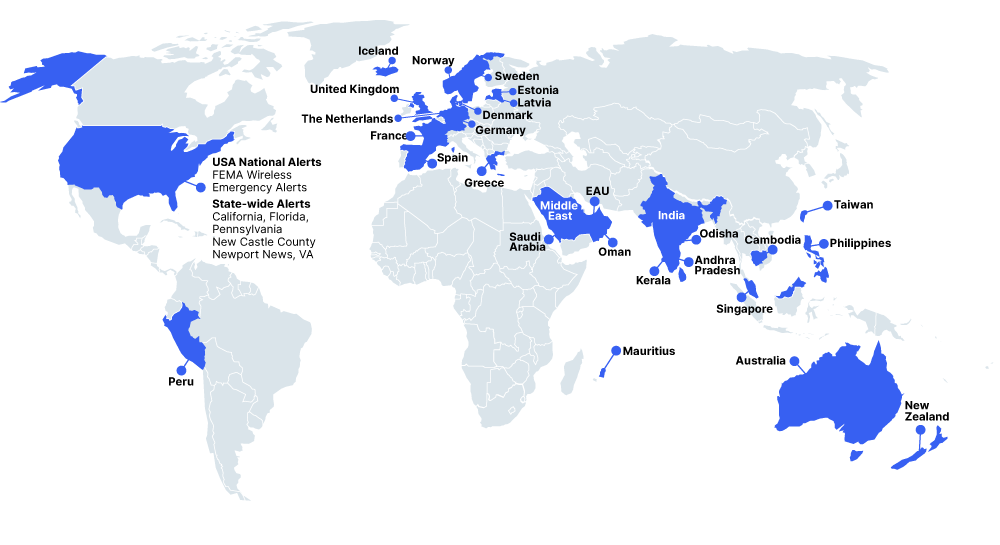
Everbridge Public Warning has been trusted and deployed by more national governments across the world than any other solution, including the United Kingdom, Germany, Norway, Sweden, Spain, the Netherlands, Greece, Iceland, Estonia, Singapore, Peru, Australia, New Zealand and several coastal states in India.
Find out how population alerting is being used in:
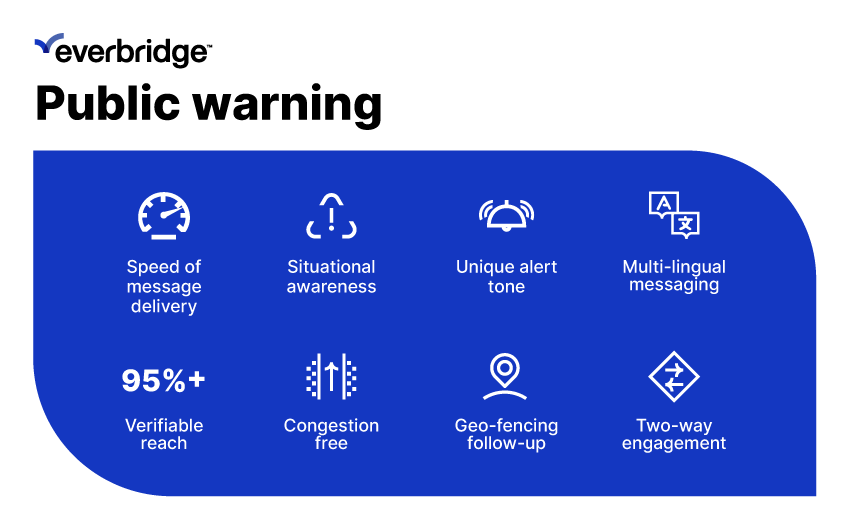
Reach millions in seconds
Everbridge is the only supplier that can offer both best of breed technologies.
- Maximize reach and performance with cell broadcast, location based SMS and address based SMS
- Gain situational awareness and visualize crowd movements
- Communicate with people in their native language
- Partner with one provider, one solution, one support desk
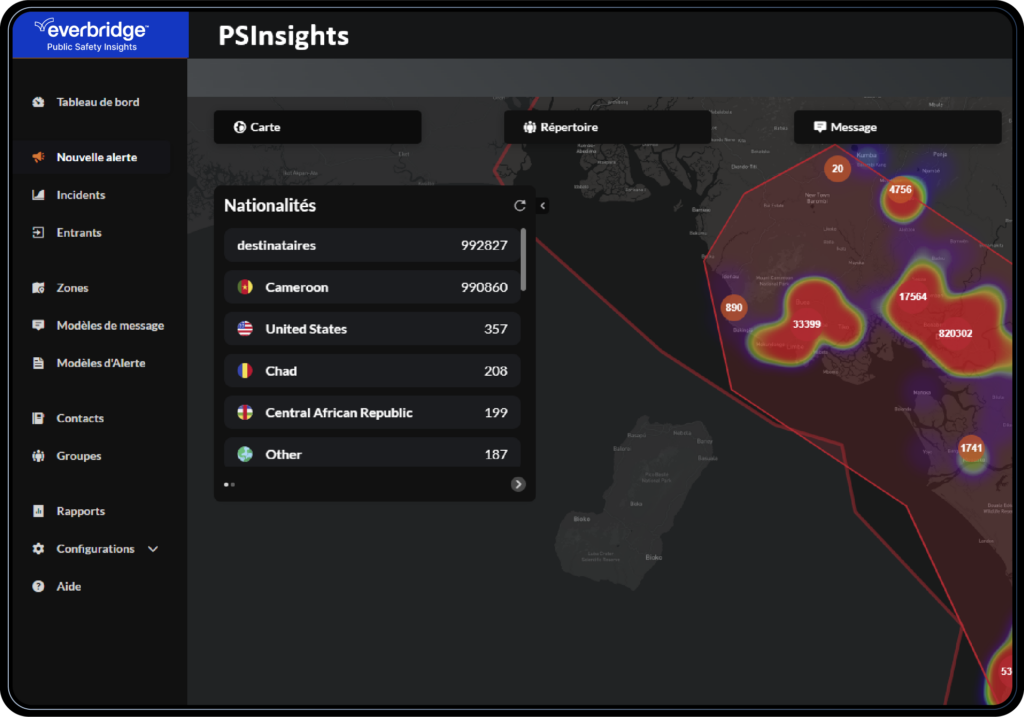
Gain deep visibility into major incident scenes
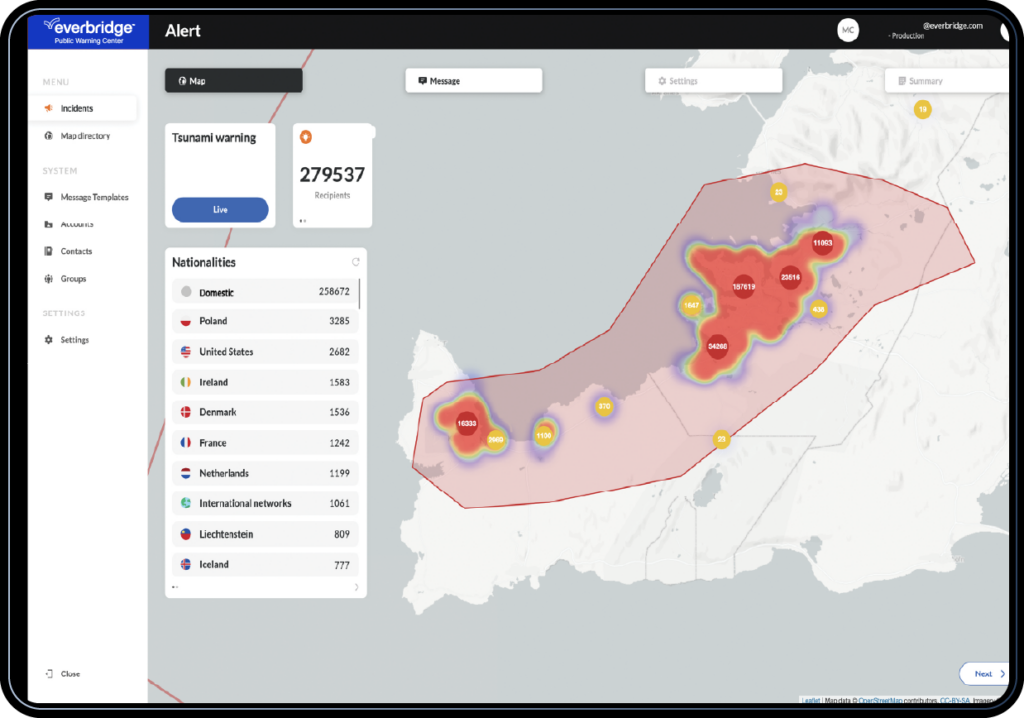
Everbridge provides public authorities with the information needed to quickly assess the public safety impact of situations in real-time, enabling them to make more informed decisions and thereby reducing the impact of incidents. It gives public authorities the ability to:
- Visualize relevant data, information and intelligence, enabling them to deploy the most effective response and achieve better outcomes
- Receive risk input data to assess the potential impact
- Monitor real-time density of mobile devices with location
- See a breakdown of devices by nationality
- View live crowd movements in the affected area
- Plug into any existing population alerting system
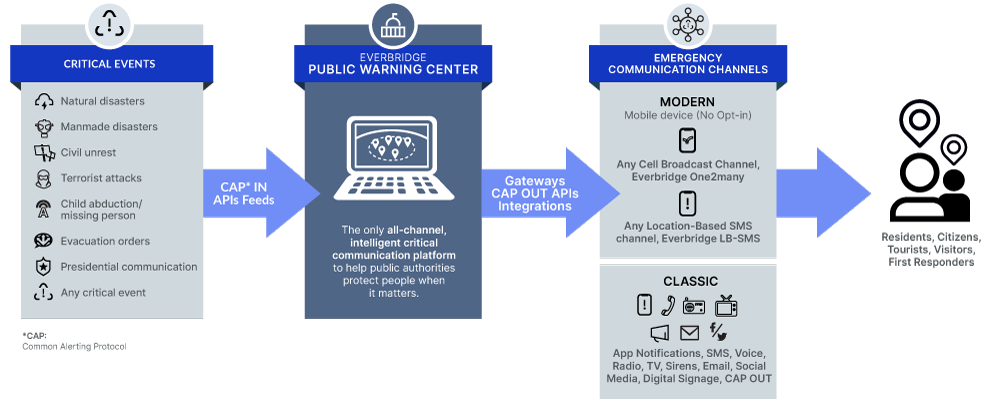
One platform – how it works
The platform seamlessly combines modern mobile phone alerting capabilities with classic communication channels such as email, voice calls, sirens , radio, tv, social media, digital signage and opt-in address based systems.
Why Everbridge?
Since 2002 we have pioneered public alerting technologies and to date Everbridge has been awarded 16 patents for innovation. Everbridge experts developed the first cell broadcast and location-based SMS solutions and are active in driving standardization of public warning worldwide through 3GPP, ATIS, ETSI and EMTEL.